Self Import Car from Canada to USA
Complete guide to importing your vehicle from Canada to the United States
Save thousands of broker fees by doing it yourself
Overview
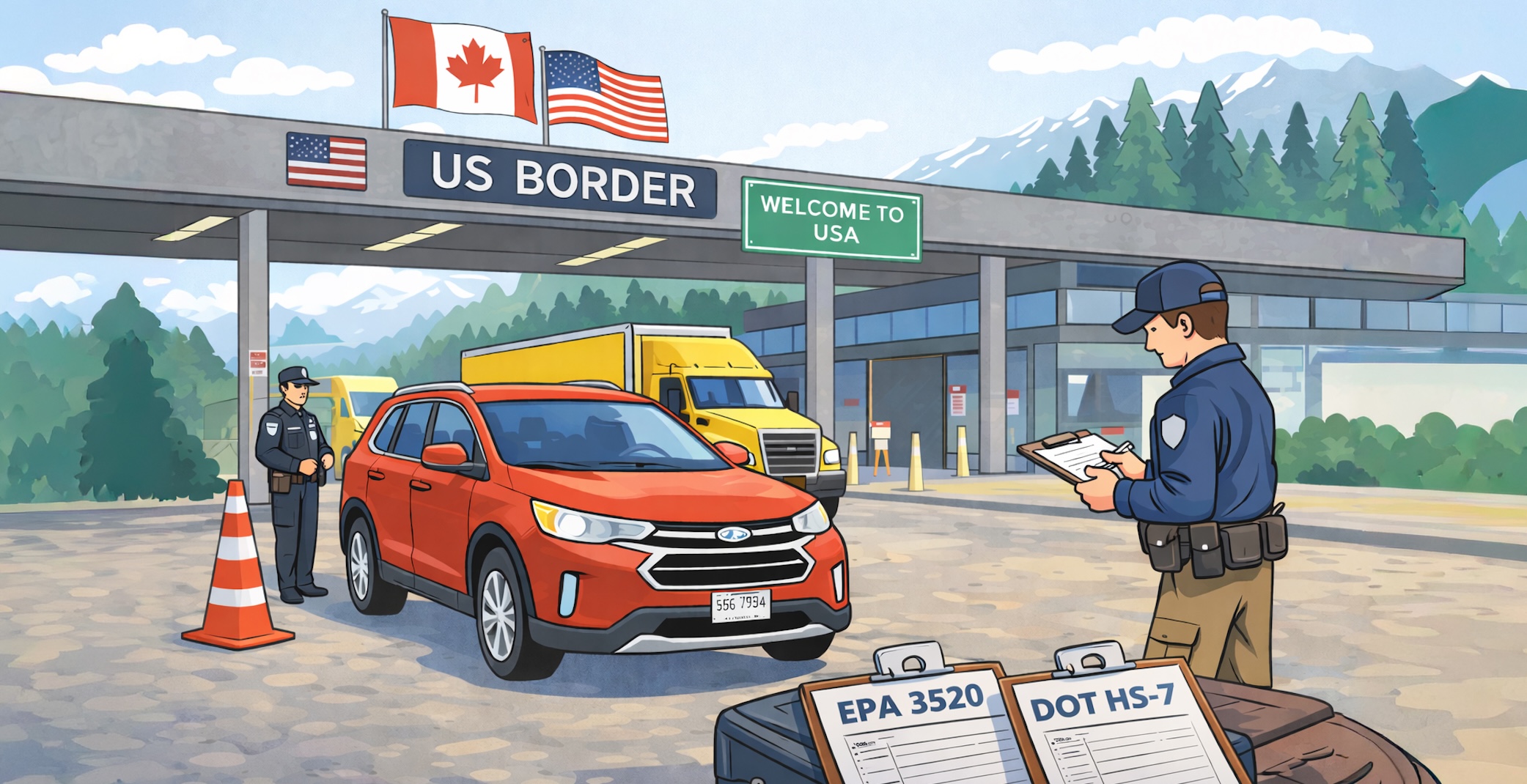
Importing a car from Canada to the United States is a straightforward process when you understand the requirements and have the proper documentation. Whether you're relocating, purchasing a vehicle from Canada, or bringing back a car you already own, this guide will walk you through everything you need to know.
The process involves meeting EPA emissions standards, DOT safety requirements, and clearing U.S. Customs and Border Protection (CBP). While it may seem complex, thousands of people successfully import vehicles from Canada each year by following the proper procedures.
Import Regulations
Your vehicle must meet EPA emissions and DOT safety standards. Most vehicles sold in Canada already comply.
EPA Emissions Regulations
- U.S. EPA Label: Vehicle is already compliant, no additional work needed.
- Canadian EPA Label: Vehicle meets equivalent regulations, acceptable for import.
- No EPA Label: Vehicle may require modifications or may not be eligible.
- 21+ Years Old: Vehicle is exempt from EPA emissions regulations if unmodified.
💡 Check under the hood in the engine compartment for the EPA emission label.
DOT Safety Standards
- FMVSS Label: Vehicle already meets U.S. safety standards.
- CMVSS Label: Vehicle has Canadian safety certification; manufacturer letter required for U.S. compliance.
- 25+ Years Old: Vehicle is exempt from safety standards.
💡 Check the driver's side door jamb for the safety certification label.
Required Documents
Having all required documents prepared before arriving at the border will ensure a smooth import process.
Essential Documents
- EPA Form 3520-1: Declaration of Conformity with EPA Emission Standards.
- DOT Form HS-7: Declaration of Conformity with DOT Safety Standards.
- Canadian Title/Registration: Proof of ownership.
- Bill of Sale: Shows purchase price and transaction details.
- Manufacturer's Compliance Letter: Required if vehicle has CMVSS label (Canadian safety certification).
- Passport: Government-issued photo ID is accepted if you are a U.S. citizen.
When to Import
You can operate a Canadian vehicle in the USA for up to 1 year without formally importing, though states may require registration sooner.
Import at the Border
Complete customs paperwork immediately when crossing. Can be stressful with unpredictable wait times and requires all documents perfectly prepared.
Important: You will need a U.S. address to complete the customs forms.
Import after Settling
Bring your vehicle into the USA and complete import later at a local CBP office (found in every state, usually near airports). More flexibility and time to prepare documents.
Important: Verify your vehicle is eligible (EPA/DOT compliance) before choosing this option.
Costs
Import Duties and Taxes
Standard Import Duty (unless made in USA or qualified under USMCA)
2.5% of vehicle value for passenger vehicles
25% for pickup trucks
Additional Tariffs
Additional tariffs of up to 25% may apply depending on the vehicle’s country of origin and current U.S. trade policies (more details).
Gas Guzzler Tax
Applies to vehicles with poor fuel economy (rare for modern vehicles)
Service Costs
Additional Costs
- Transportation: Driving yourself (gas cost) or shipping ($1000 — $2,000+).
- Titling: Varies by state ($10 — $100).
- State Registration: Varies by state ($10 — $500).
- State Sales Tax: Varies by state (waived in some states if already paid in Canada).
- State Inspections: Safety, emissions, VIN verification ($20 — $100).
Skip the Paperwork Headache
The customs forms are the most error-prone part of the import process. A single mistake can delay or reject your import. DIY Car Import pre-fills every form for your specific vehicle so you show up at the border with everything ready.
$99
Flat fee, no surprises
48 hrs
Delivery guarantee
Unlimited
Expert support included
Step by Step Import Process
Gather Required Documents and Fill Forms
Start by collecting all necessary documents and completing the required customs forms.
- Gather Canadian title/registration and bill of sale.
- Check for EPA emission label under hood.
- Check for safety certification label on driver's door jamb.
- Obtain manufacturer's compliance letter if vehicle has CMVSS label.
- Complete EPA Form 3520-1 and DOT Form HS-7.
- Prepare a draft of CBP Form 7501 (importer information, vehicle details, market value etc.).
Decide Transportation Method
Choose how you'll bring your vehicle across the border.
Drive It Yourself
Most cost-effective option. You'll drive the vehicle across the border and handle customs clearance in person.
Cost: Gas only
Hire a Transport Company
Professional auto transport service will ship your vehicle. You'll still need to be present at the border for customs clearance or arrange for a customs broker.
Cost: $1000 — $2,000+ depending on distance
Choose Port of Entry
Select the border crossing you will use to enter the United States or the CBP office you plan to use after settling in. Find CBP ports of entry.
- Choose a port of entry convenient to your location.
- Check port hours of operation (some are 24/7, others have limited hours).
- Consider traffic patterns - early morning or late evening typically have shorter wait times.
💡 Smaller ports, commuter-only crossings, or limited-service ports may not process vehicle imports. Make sure to call the CBP office and ask "Do you process personal vehicle imports, and what hours?"
Arrive at the CBP
When you arrive at U.S. Customs and Border Protection, inform the officer that you're importing a vehicle.
What to Bring
- All completed forms (EPA 3520-1, DOT HS-7, CBP 7501 draft).
- Canadian title/registration.
- Bill of sale.
- Manufacturer's letter (if applicable).
- Photo ID (driver's license or passport).
- Proof of U.S. insurance.
What Happens
- A CBP officer reviews your documents for completeness and compliance.
- You are directed to the customs office for vehicle import processing.
- A CBP officer conducts a physical inspection of the vehicle.
- Any required duties and taxes are collected.
- Your vehicle and importer details are entered into the CBP system.
- All required import forms are officially stamped and approved.
⏱️ Allow 1-3 hours for the entire process, depending on border traffic.
Get Ready for an Inspection
CBP will inspect your vehicle to verify the VIN and ensure it matches your documentation.
What They Check
- VIN verification - matches title and forms.
- EPA emission label location and information.
- Safety certification label location and information.
Preparation Tips
- Clean your vehicle inside and out.
- Remove all personal items from the vehicle.
- Ensure VIN is clearly visible on dashboard.
- Have keys ready for officer to start vehicle if needed.
Pay Duties
After inspection, you'll pay any applicable import duties and taxes.
- Payment accepted: Cash, credit/debit card.
- CBP will stamp your forms as proof of import.
- You'll receive copies of all stamped documents (EPA 3520-1, DOT HS-7, CBP 7501).
- Your vehicle is now legally imported into the United States.
💡 Keep all stamped forms - you'll need them for state registration.
Register Your Vehicle
After clearing customs, you must register your vehicle with your state's Department of Motor Vehicles (DMV) or equivalent agency.
Required Documents for State Registration
- Forms stamped by customs: EPA 3520-1, DOT HS-7, and CBP 7501.
- Canadian title: Original title or registration from Canada.
- Bill of sale: Proof of purchase.
- U.S. auto insurance: Valid insurance policy.
- Proof of US residency: Driver's license, utility bill, or lease agreement.
- Payment: Registration fees, title fees, and sales tax (if applicable).
State-Specific Requirements
Each state has different requirements for vehicle registration. Common variations include:
- Emissions testing: Required in many states.
- Safety inspection: Some states require annual safety inspections.
- VIN verification: Law enforcement or DMV must verify VIN matches documents.
- Sales tax: Some states waive if you paid Canadian sales taxes, but proof is required.
- Property tax: Some states require proof of paid property tax or non-assessment.
💡 Contact your state DMV before starting the import process to understand specific requirements.
Ready to Import Your Car?
Don't pay $1,000–$5,000 for a customs broker.
Get all your pre-filled customs forms in 48 hours for just $99 — and cross the border with confidence.
Start My Import — $99One-time fee · No subscription · Expert support included